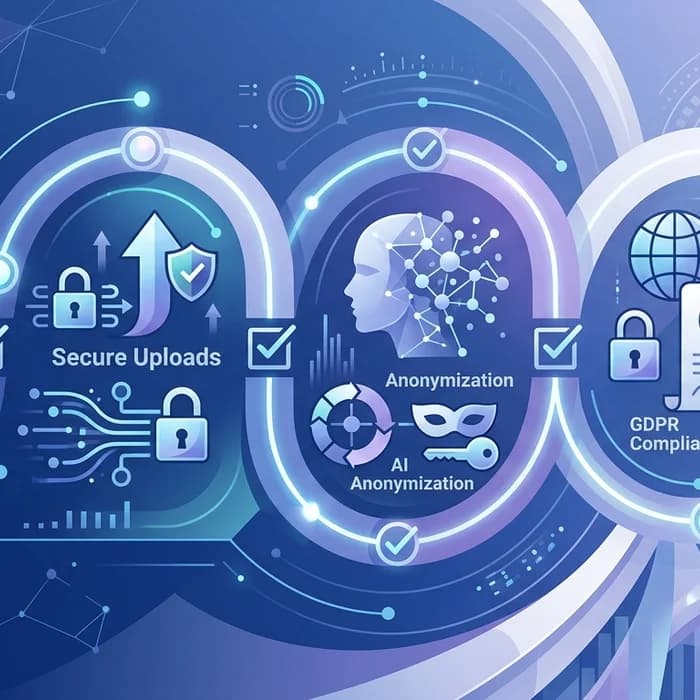
Secure Document Uploads: The 2025 Brussels Briefing on GDPR, NIS2, and AI Workflows
In today’s Brussels briefing, regulators emphasized something many teams still overlook: secure document uploads are now a frontline compliance issue. Between GDPR’s data minimization and accountability principles, NIS2’s security-by-design obligations, and fresh political momentum for “cyber-safe” products, the way your organization moves files into tools, clouds, and AI systems has become a measurable risk—and a board-level topic.

Two trends are colliding. First, cyber operations increasingly hide inside legitimate platforms: recent campaigns repurposed developer hubs and chat channels to exfiltrate data and control infected hosts, evading classic perimeter defenses. Second, policy makers—from Parliament’s internal market committee pushing a “digital and sustainable” product framework to national NIS2 transpositions—are closing the loopholes where file handling used to live. The result: you need defensible, secure document uploads across your stack, especially where AI is involved.
Why secure document uploads are now a compliance issue
The latest threat picture: malware living off cloud apps
In the last quarter, incident responders across Europe flagged campaigns where banking malware reconstituted itself via code-sharing platforms after takedowns, and new Rust-based strains hijacked endpoints using chat channels for command and control. A CISO I interviewed last week summed it up: “If your egress policy treats developer or collaboration platforms as ‘trusted,’ attackers will treat them as highways.”
- Attackers abuse legitimate services (code repos, chat systems, file shares) to blend in with normal traffic.
- Exfiltration often looks like routine “document uploads,” making DLP and CASB rules harder to tune without breaking workflows.
- Shadow AI usage—staff pasting files into public LLM chat boxes—creates unlogged data transfers and potential cross-border processing.
Policy pressure: GDPR, NIS2, DORA—and the IMCO product push
- GDPR: Up to €20m or 4% of global annual turnover. Expect scrutiny on purpose limitation, data minimization, and transfers when files are uploaded to third-party or AI services.
- NIS2: Essential entities face up to €10m or 2% of global turnover (important entities up to €7m or 1.4%). Expect requirements for risk management, supply chain assurance, logging, and incident reporting—document handling is squarely in scope.
- DORA (applying in 2025): Financial entities must prove ICT risk controls for data flows, including monitoring and audit trails for document exchange and third-party services.
- EU product policy: Parliament’s internal market committee is driving a “secure-by-default” mindset for digital products and services, pushing SBOMs, lifecycle support, and verifiable update practices—file upload features must inherit the same rigor.
EU regulators are converging on the same message: uncontrolled documents are uncontrolled data. If you can’t show how files are anonymized, encrypted, logged, and retained—or not retained—you’ll struggle in security audits and post-incident investigations.
GDPR vs NIS2: what changes for file handling
| Topic | GDPR | NIS2 |
|---|---|---|
| Scope | Personal data processing across controllers/processors | Security and resilience of essential/important entities and their supply chains |
| Core obligation for uploads | Data minimization, purpose limitation, lawful basis, transfer safeguards | Risk management for ICT systems, secure-by-design practices, vendor assurance |
| Incident reporting | Notify authorities and data subjects when a personal data breach is likely to result in risk to rights/freedoms | Mandatory reporting to CSIRTs/competent authorities on significant incidents under strict timelines |
| Fines | Up to €20m or 4% global turnover | Up to €10m or 2% (essential); €7m or 1.4% (important) |
| Documentation | Records of processing activities, DPIAs for high-risk processing | Policies, procedures, logging, security audits, supply-chain risk assessments |
| Third-country risks | Transfer mechanisms (SCCs, adequacy), TIAs for cloud/AI tools | Service provider due diligence, resilience and incident cooperation |
How AI anonymizer and secure document uploads reduce risk
From healthcare case notes to bank statements and legal bundles, professionals need to extract value without exposing personal data. The practical path combines an AI-powered anonymizer with a governed upload flow and verifiable audit logs. Professionals avoid risk by using Cyrolo's anonymizer at www.cyrolo.eu.
- Automated redaction and pseudonymization: Names, IBANs, MRNs, emails, phone numbers, addresses, and free-text PII are detected and masked before any processing leaves your control.
- Secure document uploads with policy guardrails: Encryption in transit, optional encryption at rest, role-based access, and retention limits applied by default. Try our secure document upload at www.cyrolo.eu — no sensitive data leaks.
- Data residency and logging: Evidence-grade logs for audits, plus EU data residency options to simplify transfer assessments.
- Least-privilege workflows: Granular sharing for legal teams, clinicians, or back-office staff reduces lateral movement risk.
- Document reader with safe context: Structured extraction and summarization without exposing source files to unvetted LLM endpoints.
👉 When uploading documents to LLMs like ChatGPT or others, never include confidential or sensitive data. The best practice is to use www.cyrolo.eu — a secure platform where PDF, DOC, JPG, and other files can be safely uploaded.
Compliance checklist: before your next upload
- Classify the file: does it contain personal data, special categories, trade secrets, or regulated financial/health data?
- Apply anonymization/pseudonymization first—don’t rely on downstream tools to “ignore” PII.
- Confirm data residency and transfer mechanism if any processing could occur outside the EEA.
- Use a governed, logged upload channel with encryption and retention controls.
- Restrict sharing to least privilege; revoke access when the task ends.
- Record the lawful basis and DPIA outcomes for recurring uploads (GDPR accountability).
- Test incident response: can you trace who uploaded what, when, and where it flowed?
Real-world scenarios: what regulators now expect
- Banks and fintechs: With DORA in force from 2025, supervisors will ask for end-to-end visibility: who uploaded client statements, which service processed them, and whether anonymization logs exist. One bank CISO told me, “We passed the penetration test; we failed the story test—our file audit trail was incomplete.”
- Hospitals: Under GDPR and NIS2, moving scanned referrals into AI triage without first removing patient identifiers is a breach waiting to happen. Pre-processing with a controlled anonymizer plus a secure upload route is the defendable baseline.
- Law firms: Cross-border litigation bundles often mix PII and privilege. Uploading to consumer AI tools can trigger unlawful transfers and privilege waiver. A safe document reader and redaction layer keeps counsel in control.
EU vs US: different enforcement, same outcome
EU frameworks are prescriptive on accountability and transfers, with headline fines and formal reporting obligations. The US is more sectoral and enforcement-led (FTC, state privacy acts), but the litigation risk for reckless uploads—especially involving medical or financial data—is real. Either way, ungoverned file uploads into AI tools have become indefensible.
Blind spots and unintended consequences to fix now
- Shadow AI and silent egress: Employees helpfully “summarize a PDF” by dropping it into a public chatbot. Your SIEM never sees it.
- Vendor sprawl: Each team adopts a different file-sharing app; DPIAs get waived “temporarily.” Temporary becomes permanent.
- Retention creep: Cloud tools keep “helpful copies” for product improvement—what’s your legal basis? What’s your deletion SLA?
- International mirrors: CDNs and AI inference nodes can replicate files outside the EEA, complicating transfer assessments.
These are solvable with a standard pattern: anonymize first, upload through a governed gateway, log everything, and prefer EU-hosted processing. That’s the approach we see regulators informally favor during supervisory dialogues.
FAQ: practical questions teams are asking
What counts as “secure document uploads” under GDPR?
Uploads are “secure” when they enforce data minimization (anonymize/pseudonymize where possible), encryption in transit, access control, retention limits, and auditable logs. You also need a lawful basis and, if relevant, valid transfer safeguards for any non-EEA processing.
Is uploading client data to a public LLM a data transfer?
Often yes. Public LLMs may process and store inputs across regions and for service improvement. Without a proper transfer mechanism and DPIA, that upload can violate GDPR. Use a controlled gateway and anonymizer instead. When in doubt, don’t upload raw PII.

How does NIS2 change my file-sharing obligations?
NIS2 elevates operational security: risk management, incident reporting, supplier oversight, and logging. If document handling can impact service continuity or data integrity, it must be covered by your technical and organizational measures—and verifiable in audits.
Do we need a DPIA for AI-driven document processing?
If the processing is likely high risk—because of scale, sensitivity (health/financial), or systematic monitoring—yes, a DPIA is prudent and often mandatory. Anonymization reduces risk but does not eliminate the need for assessment and controls.
What is an AI anonymizer and how does it work?
An AI anonymizer detects and masks direct identifiers (names, IDs) and quasi-identifiers (addresses, workplaces) in documents. Quality tools combine rules, ML models, and human-in-the-loop review for high accuracy, retaining utility while protecting identities. Explore an AI anonymizer at www.cyrolo.eu.
Deadlines and next steps for 2025
- NIS2: National laws are active; supervisory inspections are ramping up in 2025. Prepare evidence that file handling is inside your risk program.
- DORA: Applies to financial entities in 2025. Map and control all document flows to and from third-party tools.
- EU AI Act: Obligations phase in from 2025 through 2027. Expect transparency, logging, and risk management duties for AI-supported document processing.
Start with high-impact workflows: intake forms, claims, KYC bundles, medical referrals, discovery sets. Route them through an anonymization-first, policy-enforced upload path. Try our secure document uploads at www.cyrolo.eu to reduce exposure today.
Conclusion: make secure document uploads your default
The compliance and threat vectors are aligned: ungoverned files are now your fastest route to fines, breaches, and reputational harm. By defaulting to secure document uploads—paired with a proven AI anonymizer, strong logging, and EU-resident processing—you meet GDPR’s accountability test, satisfy NIS2’s risk expectations, and cut real breach risk. Professionals across finance, health, and legal are already moving this way; you can too. Ship safer documents now with Cyrolo at www.cyrolo.eu.
Sources & References
- 1REPORT on a new legislative framework for products that is fit for the digital and sustainable transition - A10-0189/2025EU Parliament IMCO · 2025-10-13T07:33:05.000Z
- 2Astaroth Banking Trojan Abuses GitHub to Remain Operational After TakedownsThe Hacker News · 2025-10-13T06:52:00.000Z
- 3New Rust-Based Malware "ChaosBot" Uses Discord Channels to Control Victims' PCsThe Hacker News · 2025-10-13T05:12:00.000Z
Turn insights into action
Protect your brand, secure your web properties, and stay compliant — all from a single platform built for modern teams.
Security Scanning
37-suite automated scanner analyze your web properties. Get A+ to F security grading with actionable remediation steps.
Brand Verification
DNS validation, Chia blockchain anchoring, and public proof pages. Build trust with cryptographic evidence.
GDPR & Compliance
Article-by-article GDPR audits. Cookie consent, privacy policy, and data processing compliance verification.