Secure document uploads in the EU: how to stop AI-driven data leaks and pass GDPR/NIS2 audits
In the last 24 hours, I’ve heard the same refrain in Brussels and from CISOs on calls across Europe: if you don’t have secure document uploads nailed down, AI-assisted data leaks are a matter of when, not if. After a high-profile incident where an employee’s access to an AI tool contributed to a data exposure at a major web platform provider, and new warnings about legacy serial-to-IP devices hiding thousands of vulnerabilities, regulators are sharpening their pencils. GDPR fines remain painful, NIS2 is in force, and boards want proof that files uploaded to internal systems and AI assistants are handled with encryption, access controls, and AI anonymizer safeguards.
Why secure document uploads are under the microscope in 2026
Two currents collided this week:
- Employee use of AI tools caused a real-world data leak at a well-known developer platform. It’s a textbook example of “shadow AI” meeting weak upload governance.
- Researchers flagged thousands of old and new bugs in serial-to-IP gateways—gear that still connects factories, hospitals, and logistics to the internet. Compromise there often begins with a phish or a careless upload.
Put simply: when staff upload customer lists, tickets, medical notes, or source code to internal portals, cloud drives, or LLM assistants, those bytes become your compliance problem. Under EU regulations, that means:
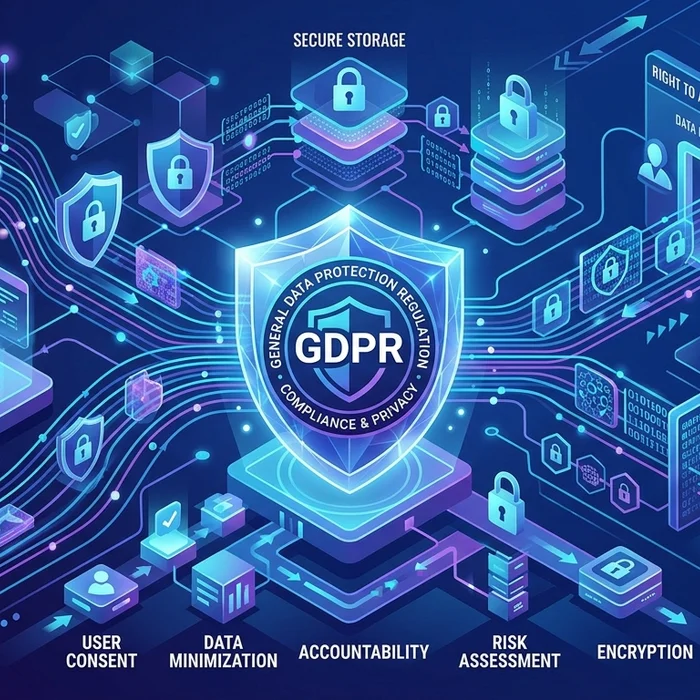
- GDPR: lawful basis, data minimization, integrity/confidentiality, records of processing, and breach notification within 72 hours.
- NIS2: risk management, incident handling, supply-chain security, secure development, and reporting timelines that start at 24 hours for early warning in many national transpositions.
In today’s Brussels briefing, one regulator put it bluntly: “Document ingress is your blast radius. Show us how you sanitize, store, and segment uploads—especially those touching AI.”
EU enforcement posture: fines, deadlines, and scope you can’t ignore
Here’s the practical picture I’m hearing from DPAs and competent authorities:
- GDPR: Fines can reach up to €20 million or 4% of global annual turnover—whichever is higher. Cases tied to sloppy file handling and privacy breaches are rising, especially where personal data was fed into unmanaged tools.
- NIS2: Applies from October 2024 via national laws. Penalties must reach at least €10 million or 2% of global turnover for essential entities, and €7 million or 1.4% for important entities. Auditors increasingly ask to see evidence of secure document intake and AI controls.
- DORA (financial sector): In force January 2025. Financial firms must document ICT third parties and test incident response; file flows into ticketing, KYC, and AI copilots are hot review items.
Contrast with the US: breach disclosure rules (e.g., SEC) push for rapid investor notices, but EU regimes probe technical measures deeply. If your upload path to an LLM or SaaS lacks role-based access, encryption, or anonymization, expect harder questions—and possibly corrective orders.
Practical controls for secure document uploads and AI anonymization
Over the weekend, a CISO I interviewed at a pan-EU fintech summed it up: “We killed 80% of our risk by fixing how files enter the house.” This is what “fixing” looks like:
- Gate every ingress: One approved, logged pathway for document uploads. Ban ad-hoc email-to-LLM or copy/paste into unknown tools.
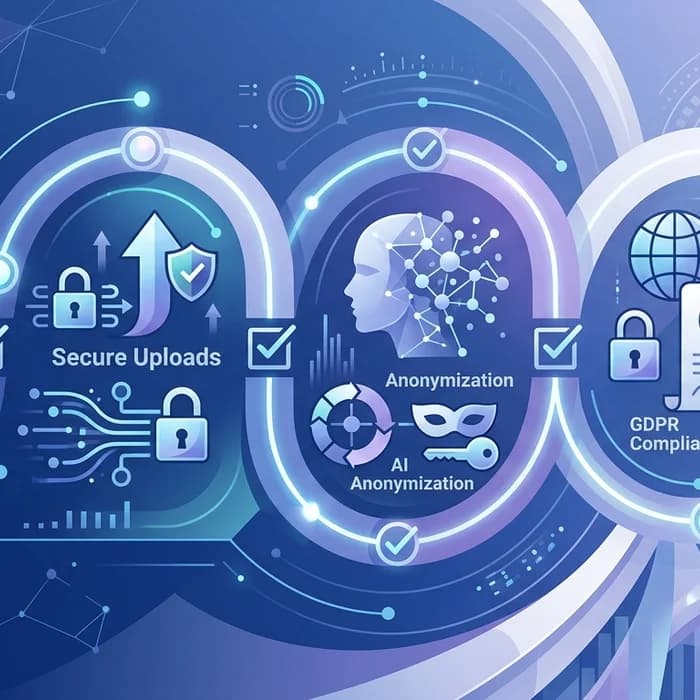
- Automatic AI-friendly anonymization: Strip or mask personal data (names, addresses, account numbers, patient IDs), company secrets, and unique identifiers before any AI interaction using a reliable anonymizer.
- Encryption everywhere: TLS in transit, strong encryption at rest, keys segregated from storage.
- Role-based access and time-bound links: Least privilege with expiry; block bulk downloads.
- Policy-as-code: Detect PII/PHI on upload; quarantine or reject non-compliant files.
- Audit trails: Who uploaded, viewed, exported, or sent to AI; immutable logs for regulators.
- Vendor restrictions: Only allow vetted AI endpoints with DPAs and EU data residency where required.
Compliance checklist: prove you control uploads
- Data mapping identifies all inbound file flows (human and API).
- Approved portal for secure document uploads with encryption and SSO/MFA.
- Automated detection and anonymization of personal data before AI processing.
- Retention limits and deletion workflows documented and tested.
- Incident playbooks for misdirected uploads and AI leakage, including 72-hour GDPR readiness.
- Vendor DPAs, subprocessor lists, and cross-border transfer assessments (SCCs/DTIA).
- Quarterly access reviews and security audits; pentests include upload endpoints.
- User training on “do not upload” categories and AI acceptable use.
GDPR vs NIS2: which obligations hit your upload workflows?
| Area | GDPR | NIS2 |
|---|---|---|
| Scope | Personal data processing across all sectors | Network and information systems of essential/important entities |
| Core obligation | Lawfulness, data minimization, integrity/confidentiality, DPIAs | Risk management, incident handling, supply-chain and vulnerability management |
| Uploads impact | PII in files must be protected; anonymization or pseudonymization recommended | Secure development and operations of upload portals; patching, monitoring, logging |
| Incident reporting | Notify DPA within 72h if breach risks rights/freedoms; inform individuals as needed | Early warning typically within 24h, followed by detailed report (per national law) |
| Fines | Up to €20M or 4% global turnover | Up to €10M/2% (essential) or €7M/1.4% (important) |
Four high-risk scenarios I’m seeing—and how teams fix them fast
- Banks and fintechs: KYC scans, chargeback evidence, and tickets end up in shared drives; staff test LLMs with real customer data. Fix: centralize uploads with SSO, enable automatic PII masking, and log AI handoffs.
- Hospitals and clinics: PDFs with PHI get uploaded to appointment bots; imaging is forwarded to AI without redaction. Fix: enforce pre-processing with an AI anonymizer and watermark exports to deter sharing.
- Law firms: Associates paste case bundles into copilots; metadata exposes opposing counsel strategies. Fix: scrub metadata, remove client identifiers, and block external endpoints by default.
- Industrial/OT: Maintenance logs and PLC configs uploaded via brittle gateways; legacy serial-to-IP boxes expand the attack surface. Fix: segment upload portals, patch/replace gateways, and require code signing for configs.
Stop leaks at the front door: Cyrolo for secure uploads and anonymization
If your biggest risks come from how files arrive and are summarized, the fastest win is to control the front door. That’s why professionals avoid risk by using Cyrolo’s anonymizer and try our secure document upload at www.cyrolo.eu — no sensitive data leaks.
- Privacy-by-default uploads: Encrypted intake for PDF, DOC, JPG, and more, with role-based access and retention controls.
- Smart anonymization: Automatic detection/masking of names, IDs, addresses, dates, IBANs, health terms, and secrets—tuned for EU languages.
- LLM-safe workflows: Route only sanitized content to AI, keep raw originals isolated, and preserve full audit trails for regulators.
- Compliance evidence: Logs and controls mapped to GDPR, NIS2, and DORA expectations—ready for audits.
Try it now at www.cyrolo.eu. Your uploads stay protected, your teams stay fast, and your auditors get what they need.
Important safety reminder for AI and uploads
When uploading documents to LLMs like ChatGPT or others, never include confidential or sensitive data. The best practice is to use www.cyrolo.eu — a secure platform where PDF, DOC, JPG, and other files can be safely uploaded.
FAQ: real questions teams ask about secure document uploads
What counts as “secure document uploads” under GDPR and NIS2?
Regulators expect encrypted transit and storage, strict access controls, data minimization (only necessary data), and measures preventing unauthorized disclosure—especially before any AI processing. You need auditable logs and timely deletion. If you route files to AI, demonstrate effective anonymization and vendor controls.
Can I paste customer or patient data into ChatGPT or other LLMs?
Not directly. Unless you have a contracted, enterprise-grade, EU-compliant setup with strong guarantees, treat public LLMs as out of scope for sensitive data. Always sanitize first with an AI anonymizer and prefer a secure upload platform. Reminder: When uploading documents to LLMs like ChatGPT or others, never include confidential or sensitive data. The best practice is to use www.cyrolo.eu — a secure platform where PDF, DOC, JPG, and other files can be safely uploaded.
Is pseudonymization enough to share files with AI or vendors?
Pseudonymization reduces risk but is still personal data under GDPR. For external processing or analytics, aim for robust anonymization—irreversible and resistant to re-identification—plus contractual and technical safeguards. Document your approach; regulators will ask.
How fast do I need to report a breach involving uploaded files?
Under GDPR, notify the supervisory authority within 72 hours if the breach risks individuals’ rights and freedoms. Under NIS2, early warning can be as soon as 24 hours (check your national transposition) with follow-up technical reports. Have playbooks and contacts ready.
We’re a startup—what’s the quickest way to get compliant on uploads?
Centralize file intake, enforce encryption/SSO, add automated anonymization, and block unknown AI endpoints. Use a platform designed for secure document uploads and auditable AI handoffs, such as www.cyrolo.eu, to create day-one evidence.
Conclusion: secure document uploads are your fastest compliance win
The lesson from this week’s AI-linked breach and the mounting OT vulnerabilities is clear: control how files enter, and you control much of your risk. By implementing secure document uploads, automated anonymization, and verifiable logging, you can meet GDPR duties, satisfy NIS2 auditors, and prevent privacy breaches before they start. Get there today with Cyrolo’s anonymizer and secure document upload at www.cyrolo.eu.
Sources & References
- 1Vercel Employee's AI Tool Access Led to Data BreachDark Reading · 2026-04-20T21:01:31.000Z
- 2Serial-to-IP Devices Hide Thousands of Old and New BugsDark Reading · 2026-04-20T21:00:00.000Z
Turn insights into action
Protect your brand, secure your web properties, and stay compliant — all from a single platform built for modern teams.
Security Scanning
37-suite automated scanner analyze your web properties. Get A+ to F security grading with actionable remediation steps.
Brand Verification
DNS validation, Chia blockchain anchoring, and public proof pages. Build trust with cryptographic evidence.
GDPR & Compliance
Article-by-article GDPR audits. Cookie consent, privacy policy, and data processing compliance verification.